 Rhinoplasty or nose surgery Common early side effects include swelling, nasal congestion and minor bleeding. Unusually severe or worsening symptoms indicate a complication – heavy bleeding, fever, pus, increasing pain, rapidly increasing swelling, or discoloration of the tip of the nose require immediate attention.
Early postoperative problems
Bleeding
Light bleeding or bloody discharge is common during the first 48 hours. Keep your head elevated, apply a cold compress to your cheeks, and follow the instructions for using the nasal spray you were given. Heavy bleeding that requires more extensive emergency intervention or hospital observation is rare.
Urgent help is needed if the bleeding is heavy, does not stop within 20–30 minutes, or if you experience weakness, dizziness, or nausea.
Infection
Infection after rhinoplasty is rare and most often occurs within the first one to two weeks. Danger signs include increasing swelling, redness, pain, fever, pus, or foul-smelling discharge after initial healing.
Take the prescribed antibiotic and follow the wound care instructions exactly as directed. Do not use someone else's medication or stop taking it unless your doctor has changed it.
Nasal skin blood supply disorder
This is a rare but serious complication. A purplish, very dark, or sharply pale tip of the nose may indicate reduced blood supply. The risk is higher if the skin of the nose has been extensively thinned, the patient has thicker skin, previous surgery, or nicotine use.
Skin discoloration requires immediate surgical evaluation. Waiting or massaging at home may worsen the condition.
Excessive swelling and nasal congestion
Pronounced swelling can be an individual healing reaction, but sometimes it is associated with increased bleeding, allergies or inflammation. Nasal congestion is very common in the first few weeks due to swelling of the mucous membrane and usually improves gradually.
If previously relieved respiratory obstruction worsens significantly, becomes permanently unilateral, or is accompanied by severe pain and discharge, the cause must be checked.
Late complications and undesirable aesthetic result
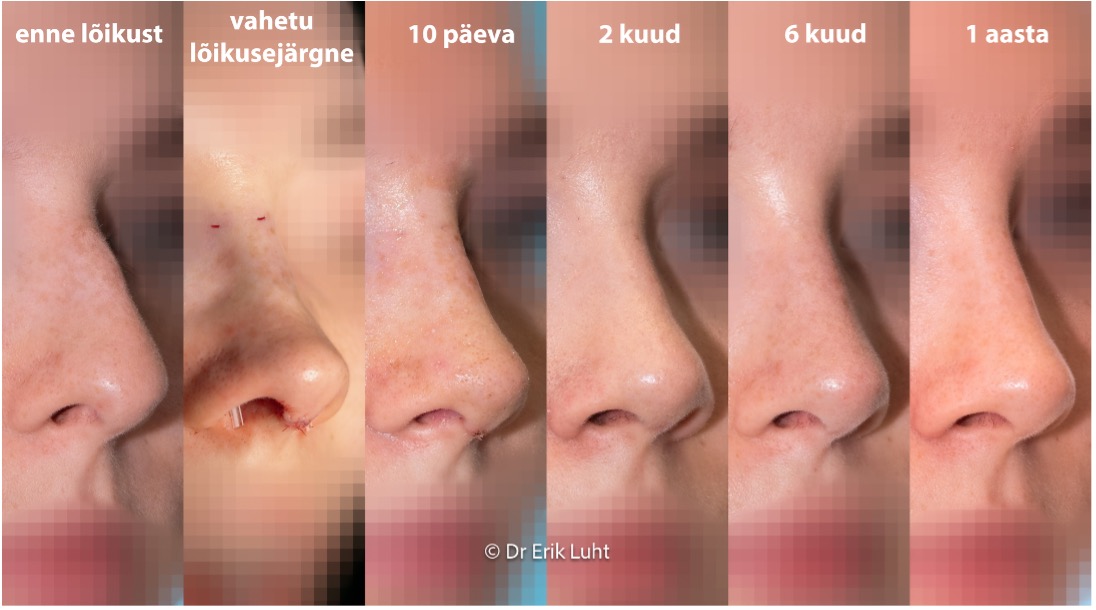
Late problems appear weeks or months later operation. Some of these will decrease as the swelling subsides; some may require minor correction or a more extensive revision rhinoplasty.
- Persistent nasal congestion: The cause may be a preserved deviation of the nasal septum, enlarged nasal sinuses, or weakness of the nasal valve.
- Long-term swelling and excess scar tissue: more common in patients with thick skin or those undergoing repeat surgery.
- A persistent bump, dent or unevenness: often becomes visible only when the swelling subsides.
- Deviation of the nasal axis: may be related to previous curvature, facial asymmetry, problems with the nasal support structure, or the scarring process.
- Permanent asymmetry of the nostrils: In the early phase, asymmetry is often greater due to swelling; a permanent difference can be corrected if necessary.
- Weakening of nasal tip support: The tip of the nose may sink downward or a lump may develop above the tip of the nose, known as a pollybeak deformity.
- Too low a bridge of the nose or an „inverted-V“ look: these may indicate insufficient midsection support.
Why doesn't every unevenness mean a complication?
Even a nose that is not operated on alone is not perfectly symmetrical, and surgery does not eliminate all facial asymmetry. Early swelling, scar tissue maturation, and skin adaptation can create temporary bumps or dimples. Therefore, the need for a repeat operation is usually not assessed within the first 6–12 months.
The exception is problems that require urgent treatment, such as infection, severe bleeding, impaired blood supply to the skin, or severe respiratory distress.
How to reduce the risk?
- Quit nicotine for the period recommended by your surgeon.
- Give a complete overview of medications, illnesses, and previous surgeries.
- Keep the splint dry, perform nasal care as recommended, and take medications exactly as directed.
- Avoid sniffing, heat, heavy lifting, and trauma to the nose in the first few weeks.
- Keep scheduled check-ups even if your recovery seems good.
Early recognition of a complication is often more important than „putting up with“ the symptoms. If in doubt, contact your clinic.