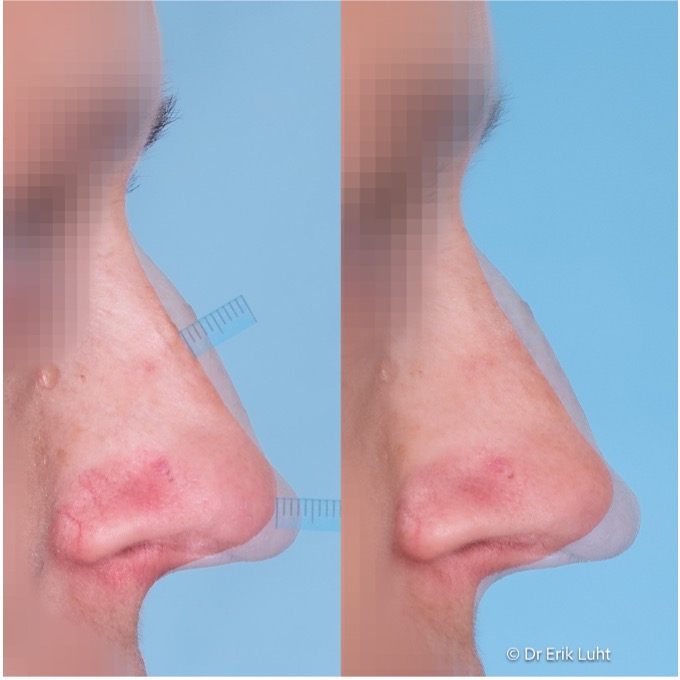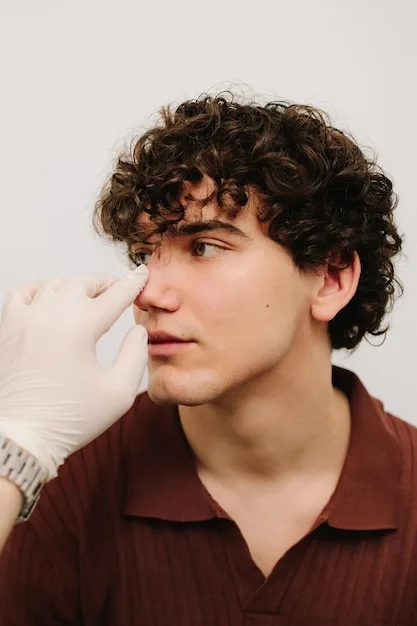
Difference between rhinoplasty, septoplasty and rhinoseptoplasty
The goal of rhinoplasty is to correct the nose. The correction can be cosmetic or functional.
Rhinoplasty focuses on changing the appearance of the nose and is therefore a cosmetic surgery. Septoplasty, on the other hand, is a functional surgery that corrects a deviated septum, or nasal septum. Rhinoseptoplasty combines both procedures – both aesthetic nose correction and functional problem resolution. Often, the transition between the two is seamless, and the improvement of nasal breathing function is accompanied by an aesthetic change.
Nasal sinus surgery is a separate procedure with a functional goal – it focuses on reducing swelling of the nasal mucosa and improving breathing.
Nasal reconstruction is a surgical procedure that aims to restore the normal appearance and function of the nose by correcting a major congenital defect, or by correcting an acquired defect, such as after trauma or after tumor removal.
What can be changed with rhinoplasty?
Operation plan are always tailored to the specific nasal anatomy, facial proportions, skin thickness and respiratory function. Possible goals include:
- Shape of the bridge of the nose: reducing the hump, raising a too low bridge of the nose or straightening the axis.
- Nose tip shape and support: narrowing the apex, changing the projection or angle of rotation, and supporting weak cartilage.
- Nose width: correction of the proportions of the bony or cartilaginous part.
- Nostrils and nasal base: Correction of excessively wide nostrils, nasal wings or noticeable asymmetry.
- Nasal breathing: treating a problem with the nasal septum, nasal sinuses, or nasal valve area if this is an indication for surgery.
A good result does not necessarily mean a smaller nose. Often the goal is a proportionate nose with a stable support structure that fits the rest of the face.
What can't rhinoplasty guarantee?
Rhinoplasty cannot make the face mathematically symmetrical or guarantee an exact result similar to a computer simulation. The sides of the face are naturally different, and cartilage, skin, scarring, and swelling respond individually to healing.
It is also not realistic to assess the final result immediately after the splint is removed. In the early stages, the nose is swollen, the tip is stiffer, and the front view may appear wider than expected. Most changes will clear up within months, even more slowly in the case of a nose with thick skin.
Open or closed rhinoplasty?
The closed method involves making incisions inside the nose. The open method adds a small incision in the anterior skin strip, or columella, of the nasal septum, so that the surgeon can expose the supporting structure of the nose more fully. Both approaches have their own indications.
The scientific literature does not show that one method always gives a better result for all patients. The choice depends on the complexity of the problem to be corrected, the support of the nasal tip, previous surgeries, and the surgeon's planned technique. Therefore, it is worth asking during the consultation not only "open or closed?", but also "why is this approach justified for my nose?".
What if I have a thick-skinned nose?
 Thick skin on the nose does not preclude rhinoplasty, but it hides the fine contours of the tip of the nose and keeps swelling away for longer. The surgery creates a bone and cartilage framework; the skin adapts to it. Thin skin shows small changes quickly, while thick skin hides both irregularities and the desired definition.
Therefore, the goal is not to create the smallest, sharpest possible framework under the skin. Too aggressive a reduction leaves the tip unsupported, and the heavy soft tissue can change shape despite the underlying framework. A nose with thick skin often also has weaker tip or septum support – the plan focuses on supporting it. A good result may mean a slightly larger, but more stable, nasal tip that fits better with the face.
The shape of the tip of the nose is more gradual than the bridge of the nose; the front view may be wider than expected for several months. The final result is often evaluated after 12-24 months. A very thin tip may not be realistic. Taping is usually more beneficial for thick skin - instructions are on the page taping after rhinoplasty.
Can the skin on the nose be made thinner?
Very careful reduction of subcutaneous tissue is possible in some situations, but aggressive skin thinning can compromise blood and lymphatic flow. This can result in long-term swelling, skin irregularities, or rarely, skin necrosis. Therefore, „skin thinning“ is not a universal solution and should be done with caution.
Correction of nostrils and nasal wings
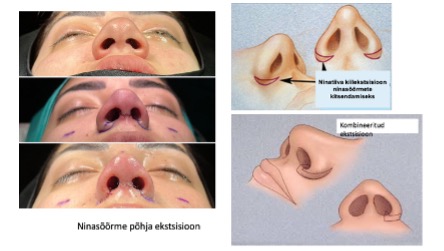 The nostrils or alar correction is considered in cases of a wide nasal base, large nostrils, severe widening of the alar wings, or persistent asymmetry. Not all wide noses require a nostril cut: the nasal base may become more proportional after correction of the tip or bridge of the nose. The decision is made based on the front, bottom, and side views, as well as the smile.
The tissue is removed conservatively. To narrow the nasal floor, a small piece is taken from the bottom of the nostril; to reduce the widening of the alar, a small wedge is taken from the edge of the alar. Both can be combined if it is necessary to change both the size of the nostril and the contour of the alar. The removed tissue does not grow back - excessive reduction can leave the nostril unnaturally small, pull the alar up, or narrow the external nasal valve and impair breathing.
The incisions are usually made at the edge of the nostril or at the junction of the ala and cheek; early scarring is visible, later less so. Complete symmetry cannot be guaranteed. The final extent is often decided at the end of the rhinoplasty, when the rest of the nose shape is in place. The goal is proportion, not maximum narrowing.
Can aesthetic rhinoplasty impair breathing?
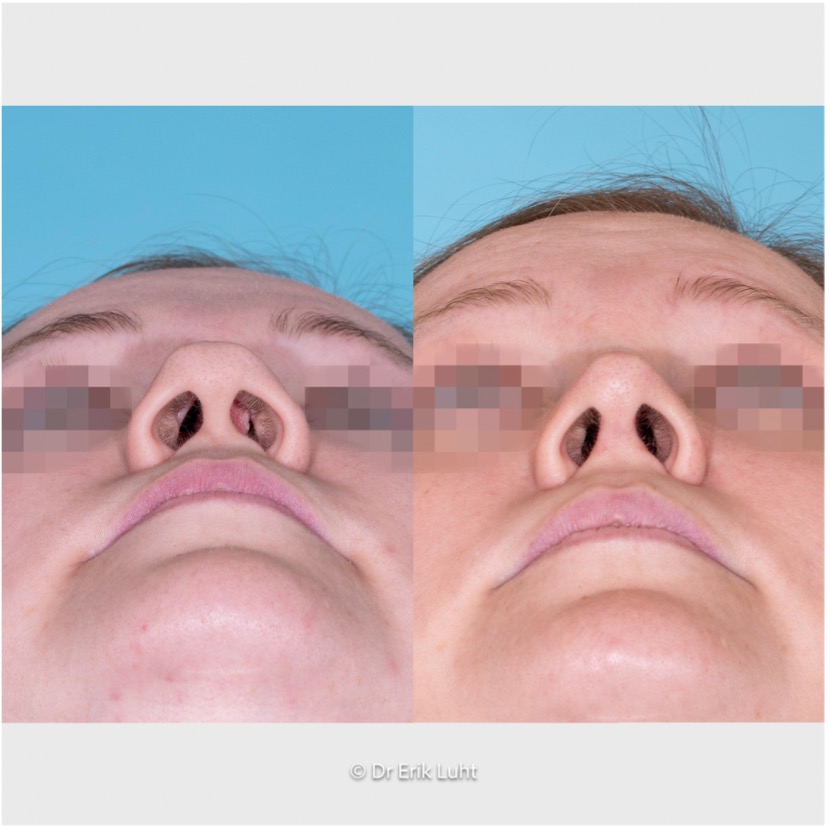 It may occur if the mid-nose or tip is made too narrow and the supporting structure is not preserved. Removing the hump on the bridge of the nose or reducing the tip of the nose must take into account the stability of the side walls and nasal valve. A smaller nose does not automatically mean a better result - the aesthetic change must not weaken the supporting structures of the nose.
The same surgery can also improve breathing if the cause of the obstruction is surgically correctable and is considered separately in the plan. Before surgery, the nasal septum, nasal cavities, and nasal valve are evaluated. Only septal surgery is septoplasty; if the problem is in the external support or flap of the nose, it is called functional rhinoplasty. They are often performed together - more specifically, it is written on the nasal septum surgery page.
Nasal congestion is common in the first few weeks, even when the goal is to improve function. Swelling, crusts, and nasal septums temporarily block airflow and do not indicate a failed surgery. Swelling-related congestion often resolves within 3-4 weeks. If breathing becomes worse after this time, remains permanently one-sided, or is accompanied by severe pain and discharge, the cause should be investigated.
Allergic rhinitis, polyps and snoring will not resolve themselves by changing the shape of the nose – they are part of nasal problems and, if necessary, septoplasty. During the consultation, it is worth asking what anatomical obstruction you actually have and how the planned aesthetic change will affect airflow.